
BLOG
- Home
- Blog
- About Motor
- What Is a VFD? Principles, Energy Savings & How to Pair the Right Motor
What Is a VFD? Principles, Energy Savings & How to Pair the Right Motor
June 08,2026
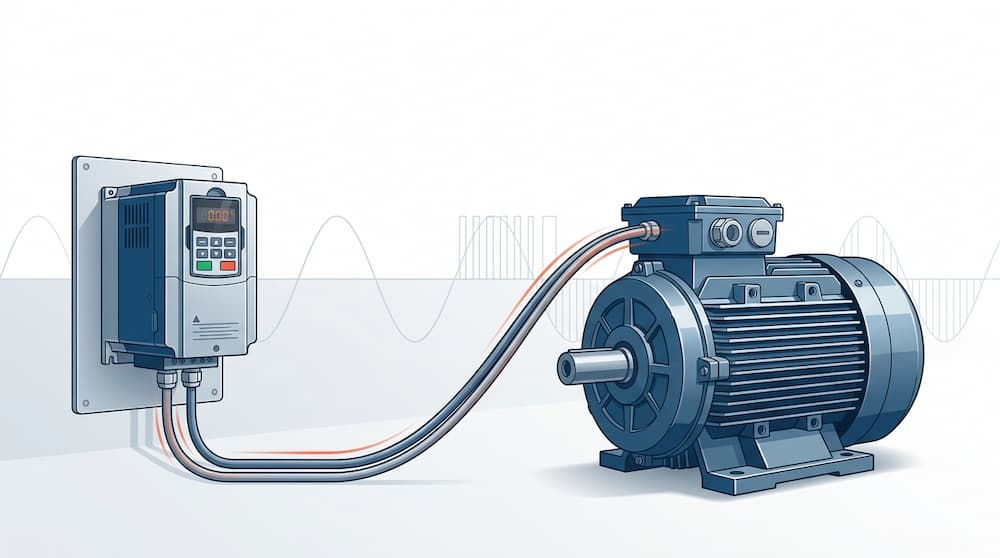
In most factories, motors run "flat out" at full speed and the output is throttled by valves, dampers or mechanical means — like driving with the accelerator floored and controlling speed only with the brake. It wastes energy and wears out equipment. A variable frequency drive (VFD) lets a motor run at "exactly the speed, and exactly the power, the job needs," making it a core component of modern factory energy savings and process control.
From a motor manufacturer's point of view, this article explains it all at once: what a VFD is, how it varies motor speed, how much energy it really saves, what effects variable-frequency operation has on the motor, and — most important — what kind of motor you should choose to pair with a VFD.
1. What Is a VFD?
A variable frequency drive (VFD, also called an inverter or adjustable-speed drive) is a power-electronics device that controls the speed and torque of an AC motor. The principle in one sentence: change the frequency of the power supplied to the motor, and you change its speed.
The speed of an AC induction motor is set by the supply frequency (synchronous speed = 120 × frequency ÷ poles). Mains power is a fixed 50/60Hz, so a motor wired straight to the mains runs at one fixed speed. A VFD converts that fixed 50/60Hz supply into a variable-frequency supply, allowing stepless speed adjustment.
2. How Does a VFD Work? Three Stages
Inside, a VFD essentially "takes the power apart and rebuilds it" in three stages:
| Stage | Component | Function |
|---|---|---|
| ① Rectify | Rectifier bridge | Converts fixed-frequency AC into DC |
| ② DC link | DC bus / capacitors | Filters, stores and stabilises the DC |
| ③ Invert | Inverter (IGBT) | Uses PWM to rebuild the DC into AC of adjustable frequency and voltage for the motor |
The key is stage three: the inverter uses PWM (pulse-width modulation) and fast IGBT switching to synthesise AC of different frequencies. This is how a VFD controls speed — but the fast PWM voltage pulses are also the root cause of the "effects on the motor" discussed later.
Most VFDs use V/f control (voltage scaled with frequency to keep flux constant); applications needing more precision use vector control, which holds high torque even at low speed.
3. Why Pair a Motor with a VFD? Four Benefits
| Benefit | Detail |
|---|---|
| Major energy savings | For fan and pump loads, the affinity laws make power roughly proportional to the cube of speed — a 20% speed cut can save nearly 50% of energy |
| Soft start, less shock | A direct-on-line start can draw 6–8× rated current, stressing the motor and sagging the grid; a VFD ramps the motor up gently, keeping starting current near rated |
| Precise process control | Stepless speed trimming improves product consistency (conveyors, mixing, extraction) |
| Longer equipment life | Smooth starts and stops reduce mechanical shock on shafts, belts and couplings |
Energy saving is the VFD's biggest selling point, especially for fans and pumps with variable loads — which is why semiconductor, food, chemical and HVAC industries adopt them so widely.
4. How Much Energy Does It Actually Save? A Fan Example
Take a 7.5kW fan motor, estimated by the affinity laws (power ∝ speed³; actual figures vary with the load curve):
| Operating method | Speed | Approx. power use |
|---|---|---|
| Full speed + damper throttling | 100% | 100% (baseline) |
| VFD reduced to 80% | 80% | About 51% (0.8³) |
| VFD reduced to 50% | 50% | About 13% (0.5³) |
In other words, if the process allows airflow to drop to 80%, energy use can be roughly halved. Motors last well over a decade, so these savings accumulate year after year. If the motor is also a high-efficiency IE3/IE4 class, overall efficiency is even better — this is exactly the "IE3/IE4 + VFD" combination that efficiency regulations often highlight.
5. What Effects Does Variable-Frequency Operation Have on the Motor? (The Part Most People Miss)
This is the section pure VFD makers rarely cover, yet it matters most for motor life. A VFD-driven motor receives fast PWM voltage pulses rather than a clean sine wave, so it faces three extra stresses:
| Effect | Cause | Countermeasure |
|---|---|---|
| Insulation degradation | The IGBT's fast voltage pulses (very short rise time) can be magnified at the motor terminals, with voltage peaks far above rated, eroding winding insulation over time | Choose an inverter-duty motor with reinforced insulation meeting NEMA MG-1 Part 31 |
| Bearing currents / bearing damage | PWM induces a shaft voltage; current discharges through the bearings to ground, gradually eroding the bearing races (fluting) | Insulated bearings, grounding ring, output filters |
| Insufficient cooling at low speed | On a TEFC motor the shaft-mounted fan slows with the motor, so long low-speed running cools poorly and temperature rise climbs | Choose an inverter-duty motor (wide speed range design); add an auxiliary fan or derate if needed |
The conclusion is clear: connect any ordinary motor to a VFD and it will turn, but over time the insulation and bearings may fail early. For reliable long-term variable-frequency operation, the motor itself must be designed for it.
6. So What Motor Should You Choose for a VFD?
Beyond power and pole count, factor "variable frequency" into the selection:
- Adequate insulation class: at least Class F is advisable for VFD use, and confirm the winding insulation can withstand PWM voltage pulses.
- Confirm inverter-duty rating: for long-term, wide-range VFD operation, choose a definite-purpose inverter-duty motor meeting NEMA MG-1 Part 31, not a standard motor that merely "runs."
- Speed range and cooling: for sustained low-speed running, evaluate cooling (auxiliary fan or derating).
- Pair with a high-efficiency class: an IE3/IE4 motor + VFD is the best combination for both regulations and overall efficiency.
- Bearing and grounding protection: for medium-to-high power or critical equipment, consider insulated bearings and grounding rings against bearing currents.
FAQ
Q: Are a VFD and a motor the same thing?
A: No. A VFD is the power-electronics device that "drives and controls speed"; the motor is the rotating machine that "delivers the power." The VFD converts fixed-frequency mains into a variable-frequency supply, and the motor turns at that frequency. They work together but are separate components, usually made by different manufacturers.
Q: Can any motor be connected to a VFD?
A: Technically most three-phase induction motors can be driven by a VFD, but "can turn" is not "can run reliably for years." A standard motor on long-term VFD duty may fail early from PWM-induced insulation degradation, bearing-current erosion and poor low-speed cooling. For long-term or wide-range VFD operation, choose a definite-purpose inverter-duty motor meeting NEMA MG-1 Part 31.
Q: How much energy can a VFD save?
A: It depends on the load type. For variable loads like fans and pumps, the affinity laws make power roughly proportional to the cube of speed — cutting speed to 80% can save nearly half the energy; to 50%, energy use may be only around 13% of the original. For constant-torque loads (such as conveyors) the savings are smaller, but soft-start and process-control benefits remain.
Q: What is the difference between a VFD-driven motor and a pole-changing motor?
A: Both control speed, but differently. A VFD-driven motor uses the drive to change supply frequency for stepless electronic speed control — wide range and fine adjustment, but it needs a VFD and attention to the effects on the motor. A pole-changing motor switches winding poles for mechanical "gear changes," giving only two or three fixed speeds, with no VFD needed, lower cost and a simpler structure. Choose VFD for stepless precise control; choose a pole-changing motor when only a few fixed speeds are needed and you want to save the VFD cost.
Why Choose Kuo Shuay Motors
An honest note first: Kuo Shuay does not manufacture VFDs themselves. A VFD is a power-electronics drive — a different product domain from motors. Kuo Shuay focuses on its core business of more than 35 years — AC induction motors, including types suited to VFD speed control.
Precisely because we specialise in the motor itself, we understand what variable-frequency operation demands of it. We operate the Asia-Pacific region's first UL motor efficiency laboratory for real-world insulation, temperature-rise and efficiency verification; our range covers IE3 and IE4 high-efficiency motors and highly customised solutions, and we can recommend the best option for your VFD application conditions (speed range, cooling, insulation class, export-market regulations).
Whether you need a high-efficiency induction motor to pair with a VFD or a custom motor with special specifications, Kuo Shuay safeguards your project from the motor side, ensuring stability and longevity under long-term variable-frequency operation.
<Further reading> What is a pole-changing motor? Speed control without a VFD
<Further reading> What is an induction motor? A complete guide
<Further reading> 2026 Motor Efficiency Regulations: IE3 & IE4 mandatory timelines and selection guide

Article Classification
Related Articles
- What Is a VFD? Principles, Energy Savings & How to Pair the Right Motor
- 2026 Motor Efficiency Regulations Explained: IE3 & IE4 Mandatory Timelines and Selection Guide
- What are IE3 and IE4 motors? Motor power and efficiency explained
- What is a Pole-Changing Motor? Speed Control Without a VFD
- Servo Motors Explained: Types, Structure and Applications