
BLOG
- Home
- Blog
- About Motor
- 2026 Motor Efficiency Regulations Explained: IE3 & IE4 Mandatory Timelines and Selection Guide
2026 Motor Efficiency Regulations Explained: IE3 & IE4 Mandatory Timelines and Selection Guide
June 03,2026
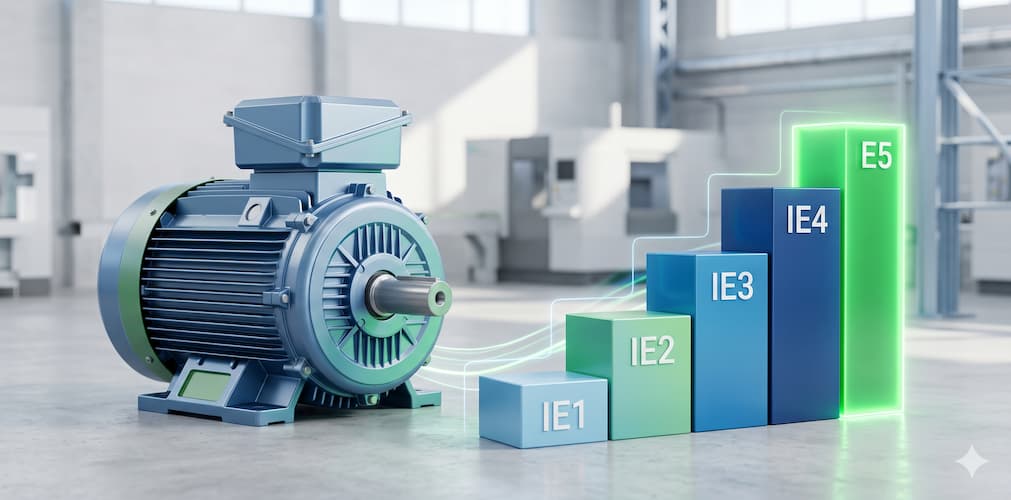
Motor efficiency class (IE Class) used to be a nice-to-have. In 2026 it has become a legal market-entry requirement in most regions. The EU, China and Taiwan have progressively made IE3 and IE4 mandatory, and non-compliant motors cannot be sold or put into service. For export-oriented factories, choosing the wrong class is not just higher energy bills — the goods may not clear customs.
This article explains it all: how IE classes are defined, mandatory timelines by country, the real payback of upgrading from IE3 to IE4, and how to choose for different industries.
1. How Are IE Efficiency Classes Defined?
IE classes are defined by the international standard IEC 60034-30-1. The higher the number, the higher the efficiency and the lower the losses:
| Class | Name | Position |
|---|---|---|
| IE1 | Standard Efficiency | Old baseline, phased out in most markets |
| IE2 | High Efficiency | Transitional, still used for small / single-phase motors |
| IE3 | Premium Efficiency | Mandatory baseline in most markets and Taiwan (<75kW) |
| IE4 | Super Premium Efficiency | Mandatory in Taiwan ≥75kW and EU 75–200kW |
| IE5 | Ultra Premium Efficiency | Defined by IEC 60034-30-2, technology frontier |
The efficiency gap looks like only a few percent, but motors run for long hours, so the cumulative electricity-cost difference is substantial — which is exactly why countries mandate upgrades.
2. Mandatory Timelines by Country (2026 Status)
Every country defines IE classes using the same international standard, IEC 60034-30-1; each then gives it legal force through its own regulation:
| Region | Regulation (legal basis) | Mandatory threshold | Effective |
|---|---|---|---|
| Taiwan | Energy Administration Act / CNS 14400 | <75kW must meet IE3; 75–200kW must meet IE4 | 2025/07 |
| EU | Ecodesign Regulation (EU) 2019/1781 | 0.75–1000kW must meet IE3; 75–200kW must meet IE4 | IE3: 2021/07; IE4: 2023/07 |
| China | GB 18613-2020 | Three-phase induction motors must meet IE3 (Grade 3) or above | 2021/06 |
| USA | EISA 2007 (administered by DOE) | General-purpose motors must meet NEMA Premium (equivalent to IE3); IE4 not yet mandatory | Since 2010 |
Clarifying the concept: The definition of IE classes (what efficiency counts as IE3 or IE4) is set by the international standard IEC 60034-30-1. Which motor must meet which class to be sold is set by each country's regulation — the EU's Ecodesign Regulation (EU) 2019/1781, Taiwan's Energy Administration Act with CNS 14400, China's GB 18613-2020, and the USA's EISA. The thresholds differ, but all reference the same IEC class definitions.
Export note: Since 2023–2025, Taiwan and the EU require IE4 for motors above 75kW (EU: 75–200kW). Before exporting, confirm the motor nameplate IE class and that IEC 60034-30-1 / local compliance documents are in order. The USA threshold is currently NEMA Premium (equivalent to IE3); IE4 is not yet mandatory.
3. Is Upgrading IE3 to IE4 Worth It? A Real Payback Calculation
Take a continuously running 7.5 kW, 2-pole three-phase motor (actual figures vary with load factor and electricity price):
| Item | Value |
|---|---|
| Motor power / poles | 7.5 kW / 2-pole |
| Annual running hours | 6,000 hours (two-shift long-run) |
| IE3 efficiency | 90.2% |
| IE4 efficiency | 91.7% |
| Annual energy saved | About 816 kWh |
| Annual saving at industrial tariff NT$5/kWh | About NT$4,080 |
| Payback on IE3–IE4 price difference | About 1–3 years in most cases |
An efficiency gain of about 1.5 percentage points seems small, but over 6,000 hours of operation it saves roughly 816 kWh and about NT$4,080 per year. Motors last well over a decade, so everything after payback is net savings. Pairing with a variable frequency drive (VFD) to match load adds further savings. This is why long-running industries such as semiconductors, food and chemicals upgrade aggressively.
4. IE5 and the Technology Outlook
IE5 (Ultra Premium Efficiency) is defined by IEC 60034-30-2 and represents today's efficiency frontier. One key engineering fact is worth stating: traditional induction motors, limited by rotor copper loss and slip, have a practical ceiling at IE4 across most power ratings and pole counts — only certain small-power, 2-pole designs have reached IE5. Achieving IE5 broadly usually requires a different topology such as a permanent-magnet synchronous motor (PMSM) or synchronous reluctance motor, often with a dedicated drive.
So for induction motors, IE4 is the highest mature, mass-producible efficiency choice available today; IE5 mostly belongs to the PMSM / reluctance-motor domain, with higher initial cost and integration barriers. Kuo Shuay continues to invest in PMSM development and will offer solutions as the technology and market mature.
5. How to Choose for Different Industries
Beyond the IE class, weigh these factors together:
- Output power and speed: Match the actual load — avoid oversizing or undersizing.
- Environment and protection (IP) rating: Choose the right IP rating for damp or dusty conditions.
- Export-market regulations: Mid-to-high power for the EU requires IE4; confirm CE and IEC compliance documents.
- Continuous vs intermittent operation: Continuous-duty motors pay back the IE4 upgrade fastest; evaluate intermittent cases separately.
- Pairing with a VFD: For variable loads, IE3/IE4 + VFD often gives the best overall efficiency.
FAQ
Q: What is the difference between IE3 and IE4 motors?
A: Both are high-efficiency classes; they differ in efficiency baseline and applicable regulation. IE3 (Premium Efficiency) is the mainstream mandatory class worldwide and in Taiwan below 75kW; IE4 (Super Premium Efficiency) is higher and is already mandatory above 75kW in Taiwan and the EU. At the same power, IE4 saves more energy but costs more upfront.
Q: What class does Taiwan's 2026 motor efficiency regulation require?
A: Under the Energy Administration rules (effective 2025/7/1), low-voltage three-phase induction motors below 75kW must meet IE3, and those 75kW and above must meet IE4. Non-compliant motors may not be manufactured or imported for domestic use.
Q: How long is the payback when upgrading IE3 to IE4?
A: For a 7.5kW, 2-pole motor running 6,000 hours a year at an industrial tariff of NT$5/kWh, the annual saving is about 816 kWh and roughly NT$4,080; the price-difference payback is about 1–3 years in most cases, with net savings thereafter.
Q: Can induction motors reach IE5?
A: It depends on power and pole count. In general, traditional induction motors are limited by rotor copper loss and slip, making broad IE5 compliance difficult, so IE5 is usually achieved with permanent-magnet synchronous (PMSM) or synchronous reluctance motors. However, certain small-power, 2-pole induction designs have already reached IE5. In practice this must be assessed case by case based on the customer's power, pole count and application — confirm feasibility with the manufacturer's technical team.
Why Choose Kuo Shuay Motors
Kuo Shuay has more than 35 years in the AC motor industry and operates a UL-certified high-efficiency laboratory for motor efficiency testing and compliance verification. End customers for our high-efficiency motors include Taiwan's largest semiconductor company and well-known enterprises in Korea and Japan, with proven product stability and quality.
Whether you need EU IE4-compliant export motors, standard IE3 motors, or a custom solution, Kuo Shuay can recommend the best option for your operating conditions and export-market requirements, with full after-sales support.
<Further reading> What are IE3 and IE4 motors? Motor power and efficiency explained
<Further reading> UL-certified high-efficiency motors
<Products> Kuo Shuay IE3 Standard Cast Iron Motors | IE4 High-Efficiency Motors
Article Classification
Related Articles
- What Is a VFD? Principles, Energy Savings & How to Pair the Right Motor
- 2026 Motor Efficiency Regulations Explained: IE3 & IE4 Mandatory Timelines and Selection Guide
- What are IE3 and IE4 motors? Motor power and efficiency explained
- What is a Pole-Changing Motor? Speed Control Without a VFD
- Servo Motors Explained: Types, Structure and Applications