
BLOG
- Home
- Blog
- About Motor
- What is an Induction Motor? A Complete Guide
What is an Induction Motor? A Complete Guide
June 23,2023
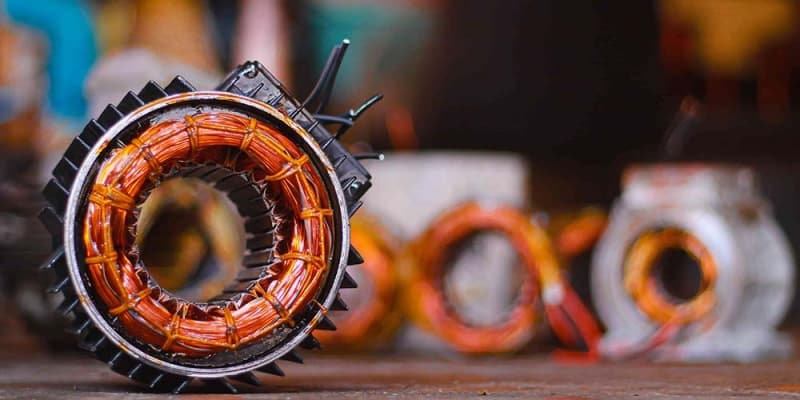
The induction motor is one of the most widely used motor types across industries, found in small appliances (like electric fans) and large machines (metallurgical machinery, machine tools). Versatile and stable, this article explains its operating principle and common applications.
What is an induction motor?
An induction motor is a type of AC motor. Its stator winding creates a rotating magnetic field that induces a current in the rotor by electromagnetic induction, driving the rotor — hence the names induction motor or asynchronous motor. It runs on AC, is simple and durable, and is low-cost to make, making it the most widely used motor type among AC and DC machines. By power source, it is divided into single-phase and three-phase.
<Product> Horizontal IE3 standard aluminum-frame motor
Single-phase induction motor
A single-phase motor's principle is more complex than a three-phase one, because a single-phase supply only produces an alternating field (varying in magnitude and direction sense, but not rotating). It therefore needs a starting winding and a running winding — one to start, one to keep running. Versus a three-phase motor of the same horsepower, single-phase is larger and less efficient, but its advantage is running on ordinary household or urban AC without needing separate three-phase industrial power — convenient and unrestricted by supply.
<Further reading> Classification of electric machines
Single-phase motor appearance: Mostly custom-designed with varied housings; most show a capacitor or capacitor cover.
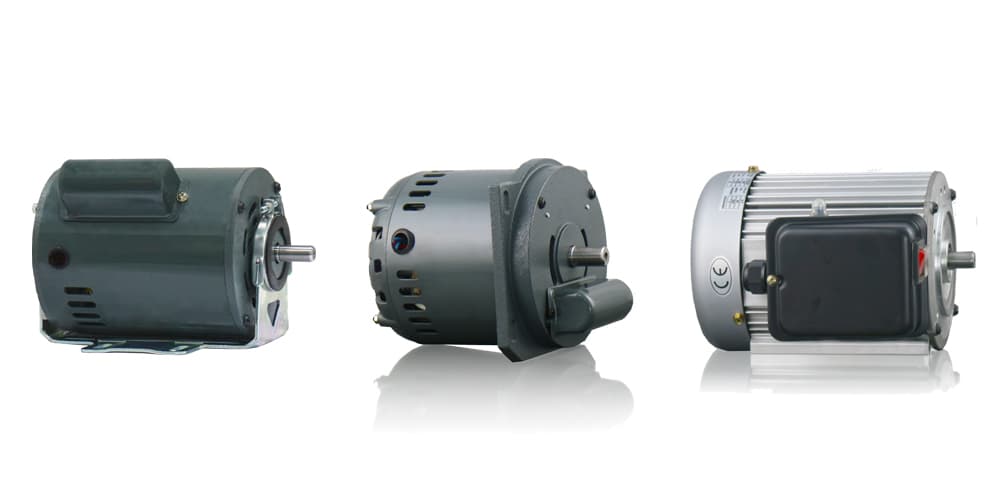
Common applications: Most home appliances — air-conditioners, refrigerators, range hoods, mixers and other kitchen appliances — use single-phase induction motors. They are chosen not only for being cheap and durable, but because they plug into an ordinary socket, adding great convenience.
<Product> Dough mixer motor
Three-phase induction motor
A three-phase motor's principle is simple: three stator windings spaced 120 electrical degrees apart, with currents 120 degrees apart in time, naturally form a rotating field that drives the rotor. It is simple, easy to maintain and lower-cost. The drawback is it needs a three-phase supply to run, so it is more restricted in use.
Three-phase motor appearance: Largely standard motors (IEC or NEMA styles), but also custom shapes to match customer machines.
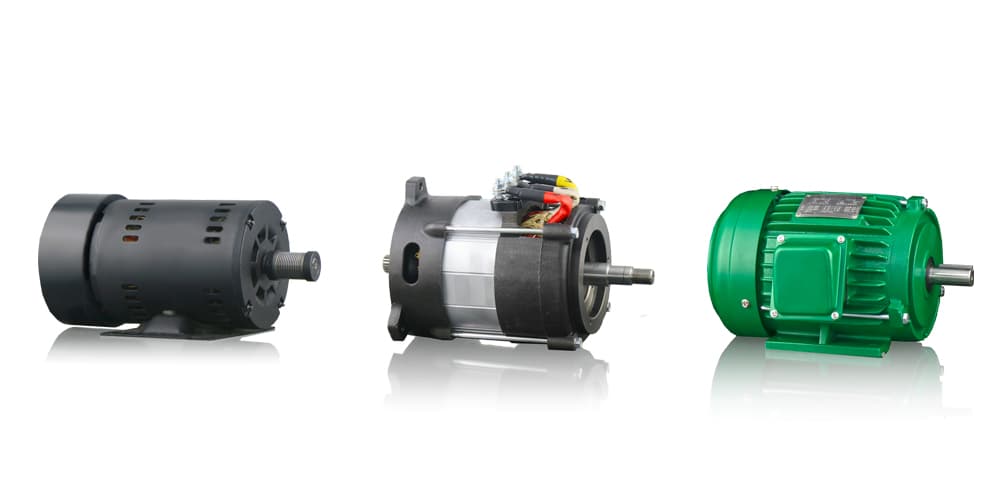
Common applications: Factory high-precision equipment often uses three-phase induction motors, mainly because they offer high output power and good efficiency to cut production cost; their simple structure rarely fails, keeping production lines stable. Three-phase supply has a fixed phase sequence that must not be wrong, but most factory machines run once wired, so sequence errors are rare.
<Product> IEC standard pump motor
Single-phase vs three-phase induction motor
| Single-phase | Three-phase | |
|---|---|---|
| Power source | AC; single-phase, plug-and-use | AC; needs three-phase, mind the phase sequence |
| Structure | More complex, needs windings for starting | Simpler |
| Efficiency | Lower | Higher |
| Manufacturing cost | Complex structure, higher cost | Simple structure, lower cost |
| Suited to | Home appliances, small/medium motors | Factory equipment, large machines |
Speed control and related applications
An induction motor cannot change speed by voltage like a DC motor. Two common methods exist: pairing with a VFD for continuous speed control, or a pole-changing (two-speed) design to switch between two fixed speeds. If precise position control is needed, that falls into the servo-motor domain. See Further Reading for the differences and selection.
Professional induction-motor manufacturer
Kuo Shuay is a professional motor manufacturer specializing in induction motors — custom, standard, VFD speed-control or energy-saving IE3 motors. We actively develop low-consumption, lightweight-material induction motors and established a motor laboratory to improve performance and cut power use; in 2011 we earned UL WTDP designated testing laboratory status, and the next year became a UL motor energy-efficiency verification laboratory — the first in Asia-Pacific.
<About us> Kuo Shuay — professional AC motor manufacturer
FAQ
Q: What is an induction motor?
A: An induction motor is a type of AC motor that drives rotation by a stator's rotating field inducing current in the rotor; it is also called an asynchronous motor. Simple, durable and low-cost, it is the most widely used motor type, split into single-phase and three-phase by power source.
Q: What is the difference between single-phase and three-phase induction motors?
A: Single-phase runs from an ordinary household socket — convenient but larger and less efficient; three-phase needs a three-phase supply, is more efficient, higher-power and lower-cost, suiting factory equipment. Appliances mostly use single-phase; industrial machines mostly use three-phase.
Q: Where are induction motors used?
A: Single-phase induction motors are common in air-conditioners, refrigerators, range hoods and mixers; three-phase induction motors are common in factory pumps, blowers, machine tools and other high-power equipment.
Q: Can an induction motor's speed be controlled?
A: Yes. It cannot be controlled by voltage, but pairing with a VFD gives continuous speed control, or a pole-changing (two-speed) design switches between two fixed speeds; precise position control requires a servo motor.
<Further reading> What is a pole-changing motor? Speed control without a VFD
<Further reading> Servo Motors Explained: Types, Structure and Applications
<Further reading> What are IE3 and IE4 motors? Motor power and efficiency explained
<Product> Kuo Shuay custom motors
Article Classification
Related Articles
- What Is a VFD? Principles, Energy Savings & How to Pair the Right Motor
- 2026 Motor Efficiency Regulations Explained: IE3 & IE4 Mandatory Timelines and Selection Guide
- What are IE3 and IE4 motors? Motor power and efficiency explained
- What is a Pole-Changing Motor? Speed Control Without a VFD
- Servo Motors Explained: Types, Structure and Applications