BLOG
High-Quality Motor Test Reports
January 02,2024
With growing global emphasis on safety and energy saving, the safety and efficiency requirements for motors keep tightening. A motor test report backed by a UL laboratory is the best assurance for export and safe use. Kuo Shuay established the first motor UL laboratory in the Asia-Pacific region, applying strict control over instrument calibration and power quality, with quarterly calibration to maintain test quality. The safety and energy-efficiency data produced by our laboratory comply with CNS 14400, UL 1004 and IEC 60034, with a measurement correlation coefficient of 0.95 or higher for strong reliability and repeatability, and the reports are recognized by international certification bodies. Further reading: Introduction to the UL Motor Laboratory.
How to Read a Motor Test Report
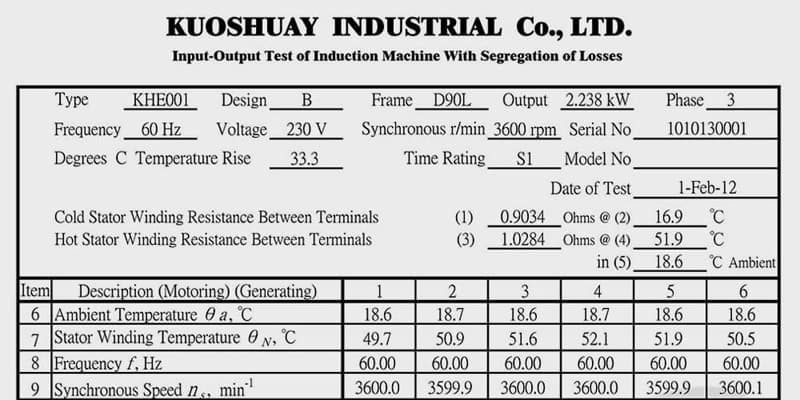
Below we use an actual Kuo Shuay "Input-Output Test with Segregation of Losses" report to explain, section by section, what a complete report should contain. Understanding these fields helps procurement and engineering teams quickly confirm whether a motor meets specification and target-market regulations.
1. Nameplate and Basic Ratings
The report header records the identity and rated conditions of the tested motor — the first step in verifying specifications:
| Field | Example | Meaning |
|---|---|---|
| Type | KHE001 | Model of the tested motor, matching the shipped item |
| Design | B | NEMA Design B, a common general-purpose torque-slip characteristic |
| Frame | D90L | Frame size, defining mounting interface and shaft diameter |
| Output | 2.238 kW | Rated mechanical output, about 3 HP |
| Phase | 3 | Three-phase induction motor |
| Voltage / Frequency | 230 V / 60 Hz | Rated voltage and frequency |
| Synchronous r/min | 3600 rpm | Synchronous speed (2-pole, 60 Hz) |
| Time Rating | S1 | Continuous duty |
| Serial No / Date | 1010130001 / 1-Feb-12 | Serial number and test date for traceability |
2. Winding Resistance: Cold vs. Hot
The report records the stator winding terminal-to-terminal resistance in both cold and hot states — for example 0.9034 Ω at 16.9°C (cold) and 1.0284 Ω at 51.9°C (hot). Because copper resistance rises with temperature, the change between cold and hot resistance lets us estimate the average winding temperature rise, a key indicator of the motor's thermal margin. The ambient temperature (e.g. 18.6°C) is also noted so data can be compared under standard conditions.
3. Temperature Rise and Load-Point Data
Temperature rise (e.g. 33.3°C) reflects how much the winding exceeds ambient at rated load; a lower value means greater thermal-design margin and longer life. The load-point table records ambient temperature, winding temperature, frequency and synchronous speed across several operating points, verifying the motor's stability and consistency under varying load.
4. Segregation of Losses — The Key to Efficiency Values
The most valuable aspect of this report is that efficiency is measured by loss segregation. Motor losses break down into stator copper loss, rotor copper loss, iron loss, friction and windage loss, and stray load loss. Compared with simply dividing measured output by input, loss segregation quantifies each loss individually for a more accurate, reproducible efficiency value — the method adopted in IEC 60034-2-1 and IEEE 112 Method B.
| Measurement Method | Principle | Use Case |
|---|---|---|
| Direct Input-Output | Divide measured input electrical power by output mechanical power | Quick estimate; instrument error is amplified |
| Loss Segregation (used here) | Quantify each loss type, then derive efficiency | High-precision certification; meets IEC 60034-2-1 / IEEE 112B |
Efficiency testing follows U.S. Department of Energy (DOE) requirements, with measured values at or above nominal ratings to pass.
One Test, Many Standards
Kuo Shuay's testing covers not only UL North American requirements but can also be adjusted and run to international IEC, U.S. IEEE, Japanese JIS, Chinese GB and other national standards. We verify motor performance with rigorous, precise procedures and instruments during design, fine-tuning against each region's regulations to confirm market fit. For different certifications across regions, the required data can be captured in a single test, reducing retest and resampling time so products reach customers faster. Further reading: UL motor test items.
More in this series: Introduction to the UL Motor Laboratory, UL-certified IE3/IE4 high-efficiency motors, UL motor test items.